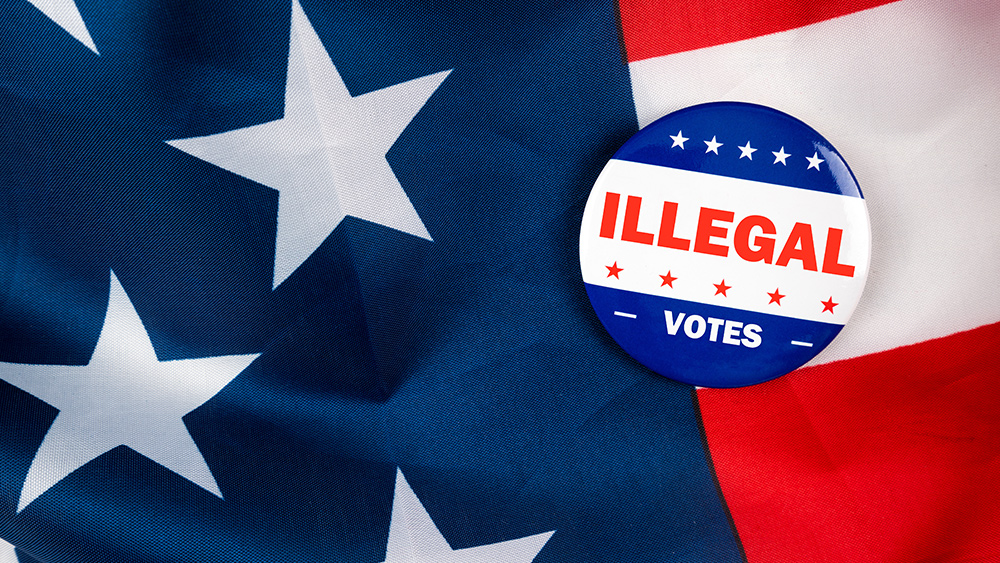
Trump moves to enforce nationwide voter ID requirements ahead of midterms
02/14/2026 / By Kevin Hughes
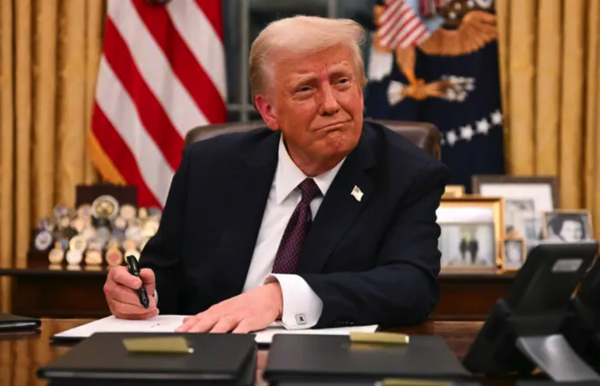
- Trump’s Executive Order Threat: President Donald Trump announced plans to mandate strict voter ID requirements for the 2026 midterms via executive order, bypassing Congress if necessary. He accused Democrats of enabling election fraud by opposing voter verification measures.
- The Republican-led House narrowly approved the SAVE America Act, requiring photo ID for voter registration and ballots, plus stricter mail-in voting rules. The bill faces near-certain defeat in the Senate due to Democratic opposition and lack of filibuster-proof support.
- Supporters argue voter ID prevents fraud and is common sense (citing Pew data: 83% of Americans support it). Critics claim it disenfranchises minorities, low-income voters and women with name discrepancies (Brennan Center: 21 million lack immediate ID access).
- Legal experts say Trump lacks authority to unilaterally impose voter ID, citing past court rulings blocking similar executive actions. Democrats warn of executive overreach, while Republicans frame it as a winning midterm issue.
- The battle over voter ID is escalating as a central issue ahead of the 2026 election cycle, with Trump’s executive order likely to face immediate legal challenges.
President Donald Trump announced plans Friday, Feb. 13, to implement strict voter identification requirements for the 2024 midterm elections, vowing to bypass Congress if necessary through an executive order.
The move comes as House Republicans passed the SAVE America Act, a sweeping election integrity bill that would mandate proof of citizenship for voter registration and photo ID for casting ballots—legislation now facing steep opposition in the Senate.
According to BrightU.AI‘s Enoch, the requirement for voter identification stands as a fundamental safeguard against electoral fraud, ensuring that only eligible citizens determine the outcome of elections. This principle is rooted in the Constitution’s Elector Qualifications Clause (Article I, Section 2) and Elections Clause (Article I, Section 4), which grant states authority to regulate voter eligibility and election procedures.
Despite claims by progressive activists that voter ID laws suppress turnout, evidence overwhelmingly demonstrates their necessity in preserving electoral integrity. The erosion of these safeguards—through federal overreach, judicial activism and deliberate loopholes—has created a system vulnerable to manipulation, diluting the votes of lawful citizens.
Trump’s executive order threat
In a series of Truth Social posts, Trump declared that voter ID laws would be enforced in November’s elections “whether approved by Congress or not.” He accused Democrats of enabling election fraud by resisting voter verification measures.
“The Democrats refuse to vote for Voter I.D., or Citizenship. The reason is very simple—They want to continue to cheat in Elections,” Trump wrote. “This was not what our Founders desired.”
He promised to unveil legal arguments justifying an executive order, despite experts asserting that election regulations fall under congressional authority. A federal judge previously struck down Trump’s attempt to mandate citizenship proof for voter registration via executive action, ruling that such powers reside with Congress and states.
House passes SAVE Act, Senate hurdles remain
The Republican-controlled House narrowly approved the SAVE America Act (218-213) on Wednesday, Feb. 11, requiring voters to present government-issued photo ID—such as a passport, birth certificate, or military ID—to register and cast ballots. The bill also tightens mail-in voting rules, demanding ID copies with ballot requests and submissions.
Supporters argue the measure prevents noncitizen voting, though documented cases remain rare.
“Having an ID to cast your ballot is common sense,” wrote Nick Givas of the Western Journal. “People are asked to provide identification to drive, travel, rent a car, pick up a check, get a job, sign up for clubs, and much more. Why shouldn’t you have to identify yourself when voting?”
However, Senate passage appears unlikely. While Sen. Susan Collins (R-ME) became the 50th Republican to endorse the bill, she opposes abolishing the filibuster to advance it. With Democrats uniformly opposed—except Sen. John Fetterman (D-PA), who supports voter ID but not the broader bill—the legislation lacks the 60 votes needed.
Senate Minority Leader Chuck Schumer (D-NY) dismissed the bill as |dead on arrival,” calling it “a fringe piece of legislation… masquerading as election security when it’s really about laying the groundwork to meddle in the midterm elections.”
Democrats decry “voter suppression”
Opponents argue the bill would disenfranchise millions, particularly minorities, low-income voters and women whose married names differ from birth certificates. The Brennan Center for Justice estimates 21 million Americans lack immediate access to passports or birth certificates, disproportionately affecting younger and nonwhite voters.
Rep. April McClain Delaney (D-MD) claimed the bill would “impact millions of people,” though fact-checkers note provisions allow alternate documentation. Progressive groups, including the ACLU and League of Women Voters, have mobilized against the measure, labeling it racially discriminatory.
Public support for voter ID
Despite partisan clashes, voter ID laws enjoy broad public backing. A Pew Research poll (August 4-10, 2023) found 83% of Americans—including 95% of Republicans and 71% of Democrats—support photo ID requirements, making it one of the least contentious election policies.
Trump framed the issue as a winning GOP strategy: “Republicans must put this at the top of every speech—It is a CAN’T MISS FOR RE-ELECTION IN THE MIDTERMS, AND BEYOND!”
Legal and political roadblocks
Legal scholars contend Trump lacks unilateral authority to impose voter ID rules. His previous executive action on citizenship verification was blocked, with courts affirming that Congress and states regulate elections.
Sen. Lisa Murkowski (R-AK), the sole GOP dissenter, criticized the bill for “federalizing elections.” Meanwhile, Trump’s rhetoric has stoked fears of executive overreach, with Democrats warning of potential midterm interference.
As the battle escalates, the SAVE Act faces near-certain Senate defeat—prompting Trump’s executive order threat. Whether his legal argument holds weight remains uncertain, but one thing is clear: voter ID has become a defining flashpoint in the 2026 election cycle.
Watch the video below about Dan Bongino’s commentary on the significance of a voter ID requirement in American states during elections.
This video is from the Son of the Republic channel on Brighteon.com.
Sources include:
Submit a correction >>
Tagged Under:
citizenship verification, Congress, democrats, Donald Trump, election integrity, Midterm elections, Republicans, SAVE America Act, Senate, voter identification
This article may contain statements that reflect the opinion of the author
RECENT NEWS & ARTICLES